Tour de France 2026: Route, Stages, Favorites, and Broadcast Overview
An overview of the Tour de France 2026, including route details, key stages, favorites, and broadcast information.
Tour de France 2026: Route, Stages, Favorites, and Broadcast Overview
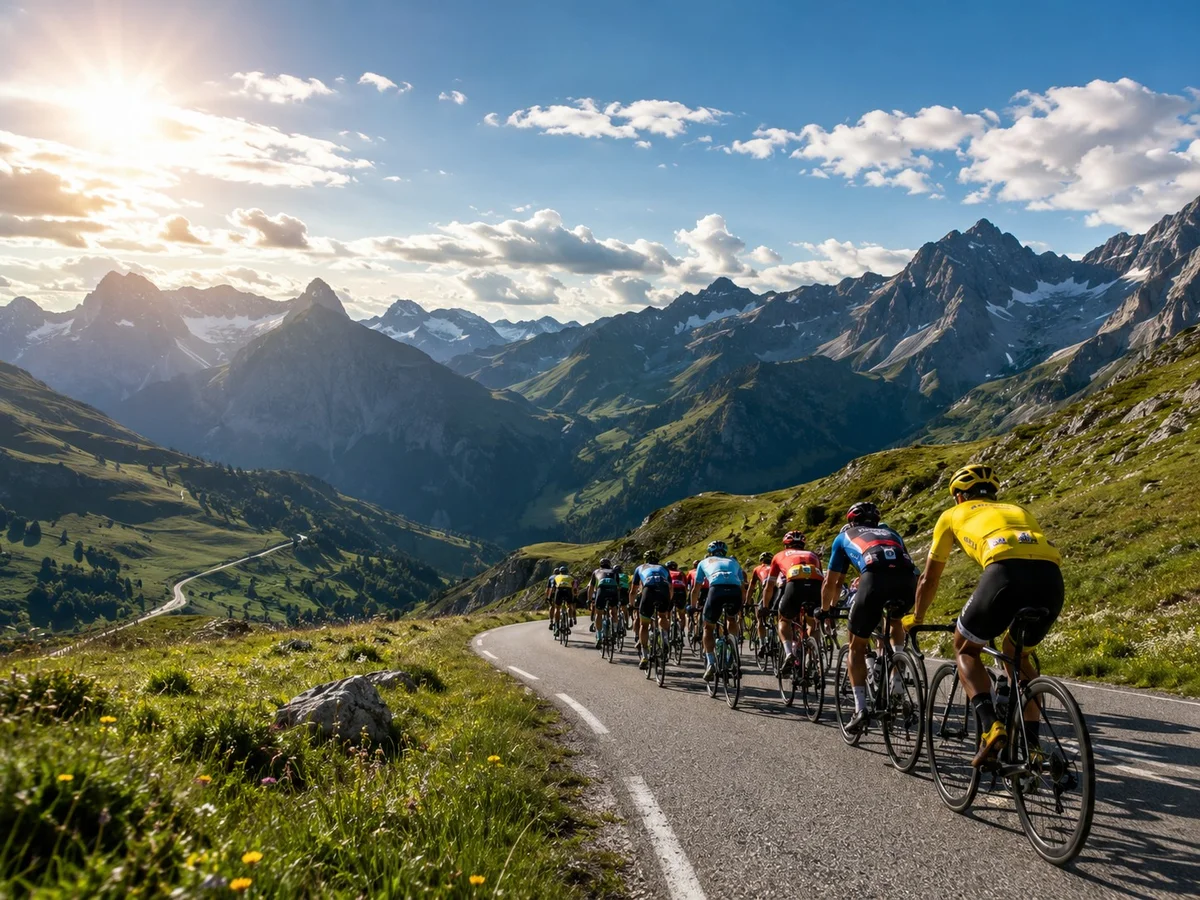
The 2026 Tour de France is set to kick off on July 4 in Barcelona, concluding on July 26 in Paris. The race will cover a total of 3,321.2 kilometers across 21 stages, featuring a route that promises to generate excitement from the start and intensify significantly in the final week. The event will begin with a team time trial, followed by a challenging course that includes the Pyrenees, Massif Central, Vosges, Jura, and the Alps. This article provides insights into the route, key stages, favorites, German riders, jersey competitions, as well as broadcast and livestream details.
Quick Summary: Key Points about the Tour de France 2026
- The Tour de France 2026 will take place from July 4 to July 26, featuring 21 stages with a total distance of 3,321.2 kilometers.
- The Grand Départ is in Barcelona, with the finale traditionally held on the Champs-Élysées in Paris.
- The opening stage includes a team time trial, which can create early time gaps in the general classification.
- The route traverses the Pyrenees, Massif Central, Vosges, Jura, and Alps, making it one of the most diverse routes in recent years.
- Riders will face five mountain finishes and a individual time trial in the third week.
- The most challenging stages are intentionally placed towards the end of the tour, keeping the battle for the yellow jersey competitive until the final moments.
- This article includes a complete overview of the stages, an analysis of the route, key favorites, and all broadcast information.
Overview of the Tour de France 2026
Period: July 4 - July 26, 2026 Total Distance: 3,321.2 kilometers Stages: 21 Start: Barcelona (Spain) Finish: Paris (Champs-Élysées) Rest Days: 2 Time Trials: 1 team time trial, 1 individual time trial Stage Profiles: 7 flat stages, 4 hilly stages, 8 mountain stages Mountain Finishes: 5
What Makes the Tour de France 2026 Unique?
The organizers of the 2026 Tour de France focus less on spectacular single moments and more on a steadily increasing level of difficulty. The team time trial in Barcelona may already create early distinctions among the favorites before the route transitions from medium mountains to the high Alps.
Crucial attacks for the yellow jersey are likely to occur in the third week, where an individual time trial and several demanding Alpine stages will challenge riders who have already endured two intense weeks of racing. This combination makes the 2026 Tour a contest where consistency and team strength will likely outshine individual breakaway performances.
Critical Aspects
The Tour de France 2026 rewards well-rounded riders. To contend for the overall victory, competitors must excel in time trials, maintain consistent performance in the mountains, and rely on a strong team over the three-week race. This versatility will likely dictate the outcome of the Tour.
Route and Stages: The Complete Tour Plan
The 2026 Tour de France spans 21 stages and 3,321.2 kilometers from Barcelona to Paris. The route is structured with a technical start, early mountain stages, a lengthy middle section allowing opportunities for sprinters and breakaways, and a tough finale in the Alps.
Notably, the mix of time trials and high mountains stands out. The team time trial in Barcelona could establish early time differences, while the third week features an individual time trial, Orcières-Merlette, and two stages finishing at Alpe d’Huez.
Why This Route is Exciting
The 2026 Tour compels favorites to focus early and maintain endurance later. Riders who lose time in Barcelona must respond quickly in the Pyrenees. Conversely, overextending in the early stages could have repercussions in the Alps. This balance renders the route tactically challenging.
All 21 Stages of the Tour de France 2026
| Stage | Date | Start – Finish | Profile | Distance | |-------|-------------|-------------------------------------|------------------|-----------| | 1 | July 4 | Barcelona – Barcelona | Team Time Trial | 19.6 km | | 2 | July 5 | Tarragona – Barcelona | Hilly | 168.5 km | | 3 | July 6 | Granollers – Les Angles | Mountains | 195.9 km | | 4 | July 7 | Carcassonne – Foix | Hilly | 181.9 km | | 5 | July 8 | Lannemezan – Pau | Flat | 158.3 km | | 6 | July 9 | Pau – Gavarnie-Gèdre | Mountains | 186.2 km | | 7 | July 10 | Hagetmau – Bordeaux | Flat | 175.1 km | | 8 | July 11 | Périgueux – Bergerac | Flat | 180.4 km | | 9 | July 12 | Malemort – Ussel | Hilly | 185.5 km | | 10 | July 14 | Aurillac – Le Lioran | Mountains | 166.6 km | | 11 | July 15 | Vichy – Nevers | Flat | 161.3 km | | 12 | July 16 | Circuit Nevers Magny-Cours – Chalon-sur-Saône | Flat | 179.1 km | | 13 | July 17 | Dole – Belfort | Hilly | 205.8 km | | 14 | July 18 | Mulhouse – Le Markstein Fellering | Mountains | 155.3 km | | 15 | July 19 | Champagnole – Plateau de Solaison | Mountains | 183.9 km | | 16 | July 21 | Évian-les-Bains – Thonon-les-Bains | Individual Time Trial | 26.1 km | | 17 | July 22 | Chambéry – Voiron | Flat | 174.7 km | | 18 | July 23 | Voiron – Orcières-Merlette | Mountains | 185.2 km | | 19 | July 24 | Gap – Alpe d’Huez | Mountains | 127.9 km | | 20 | July 25 | Le Bourg-d’Oisans – Alpe d’Huez | Mountains | 170.9 km | | 21 | July 26 | Thoiry – Paris Champs-Élysées | Flat | 133.0 km |
Key Stages
1. Stage: Team Time Trial in Barcelona
The opening stage is anything but a warm-up. Teams with strong time trial structures can gain immediate advantages, while poorly organized squads may find themselves under pressure from the outset.
3. Stage: Granollers – Les Angles
The first mountain stage comes unusually early. While it may not determine the Tour, it can reveal which favorites are stable in the first week.
6. Stage: Pau – Gavarnie-Gèdre
This Pyrenean stage serves as the first major test. Riders showing weakness here will need to adopt a more aggressive approach for the remainder of the Tour.
16. Stage: Individual Time Trial at Lake Geneva
Post the second rest day, the individual time trial can significantly alter the overall standings. It poses particular risks for pure climbers who will need to recover time in the subsequent mountain stages.
20. Stage: Le Bourg-d’Oisans – Alpe d’Huez
The penultimate stage is likely the most critical day of the race. After nearly three weeks, not only climbing strength will matter but also recovery, team support, and mental resilience.
Route Analysis: Where Can the Tour Be Decided?
The 2026 Tour de France is unlikely to be decided on a single day. The route is designed to allow time gaps to develop at multiple points: in the team time trial, during early mountain finishes, in the individual time trial, and ultimately in the Alps.
The third week will be particularly crucial. Following the individual time trial, riders will face three difficult mountain days in quick succession: Orcières-Merlette and two stages at Alpe d’Huez. Those who are not fresh by this point risk losing several minutes, even with a strong team.
For the favorites, this means that mere patience will not suffice. The Tour demands early control, smart energy management, and timely attacks. The combination of time trials and high mountains favors well-rounded riders rather than specialists.
Favorites for the Overall Victory
The battle for the yellow jersey in the 2026 Tour de France is currently shaping up as a duel between Tadej Pogačar and Jonas Vingegaard. Behind them, the competition heats up with Remco Evenepoel, Florian Lipowitz, Paul Seixas, and Isaac del Toro, each bringing distinct strengths to this mountainous race.
The analysis of the favorites is based on the official starter list, confirmed team line-ups, and current pre-race reports. Last-minute changes due to injuries, form issues, or team decisions may still occur before the start.
Who is the Top Favorite for Yellow?
Tadej Pogačar enters the 2026 Tour de France as a clear benchmark. He possesses the best combination of explosiveness, climbing ability, time trial strength, and race dominance. Vingegaard remains his most formidable rival, as the route with its lengthy alpine stages and high demands in the third week suits his profile as well.
Comparison of Favorites: Strengths, Risks, and Winning Chances
| Rider | Team | Strengths | Risks | Ranking | |------------------|-----------------------------|--------------------------------------|-----------------------------------------|-------------------| | Tadej Pogačar | UAE Team Emirates-XRG | Mountains, time trial, attacks, team depth | High expectations, need for early control | Top Favorite | | Jonas Vingegaard | Visma | Lease a Bike | Long climbs, recovery, third week | Wout van Aert missing from Tour team | Main Opponent | | Remco Evenepoel | Red Bull-BORA-hansgrohe | Time trial, pace, tactical aggression | Heavy alpine blocks at the end | Podium Candidate | | Florian Lipowitz | Red Bull-BORA-hansgrohe | Climbing, consistency, strong development | Role alongside Evenepoel | Outsider for Podium| | Paul Seixas | Decathlon CMA CGM | Climbing talent, lightness, home advantage | Tour debut, pressure in France | Top-10 Candidate | | Isaac del Toro | UAE Team Emirates-XRG | Mountains, dynamism, strong support role | Clear hierarchy behind Pogačar | Support with own options|
Pogačar: The Rider Everyone Must Beat
Pogačar enters the race as the defending champion and clear favorite. UAE Team Emirates-XRG has assembled a strong team around him, featuring climbing helpers and rouleurs for the team time trial. His greatest strength lies in his ability to gain time on almost any terrain.
Vingegaard: The Most Dangerous Opponent in Week Three
Vingegaard remains the rider most capable of consistently pressuring Pogačar in the mountains. The final week with Orcières-Merlette and two stages at Alpe d’Huez aligns perfectly with his strengths. A key factor will be whether Visma can maintain control without Wout van Aert.
Evenepoel and Lipowitz: A Dual Threat with Risks and Opportunities
Red Bull-BORA-hansgrohe brings two riders with podium ambitions in Evenepoel and Lipowitz. Evenepoel can gain significant time in the time trial, while Lipowitz appears particularly interesting for the long mountain stages. The crucial question is whether this will serve as a tactical advantage or lead to internal role conflicts.
Analysis
The route does not favor a pure time trialist or a pure climber. The winner must excel at both: not losing time in the team time trial, maintaining stability in the individual time trial, and being fresh enough in the Alps to respond to attacks.
Thus, Pogačar stands out as the logical number one. Vingegaard is the most dangerous challenger when the Tour becomes a test of endurance in the third week. Evenepoel, Lipowitz, and Seixas will likely need a near-perfect race to disrupt the duel between the two top favorites.
German Riders: Chances, Roles, and Stage Goals
From a German perspective, the focus in the 2026 Tour de France will primarily be on Flo...