JWST Studies the Surface of a Rocky Exoplanet for the First Time - Space Tale
The James Webb Space Telescope has characterized the surface of a rocky exoplanet for the first time, revealing a dark, hot world without an atmosphere. Discover the implications for exoplanet geology and the search for habitable planets.
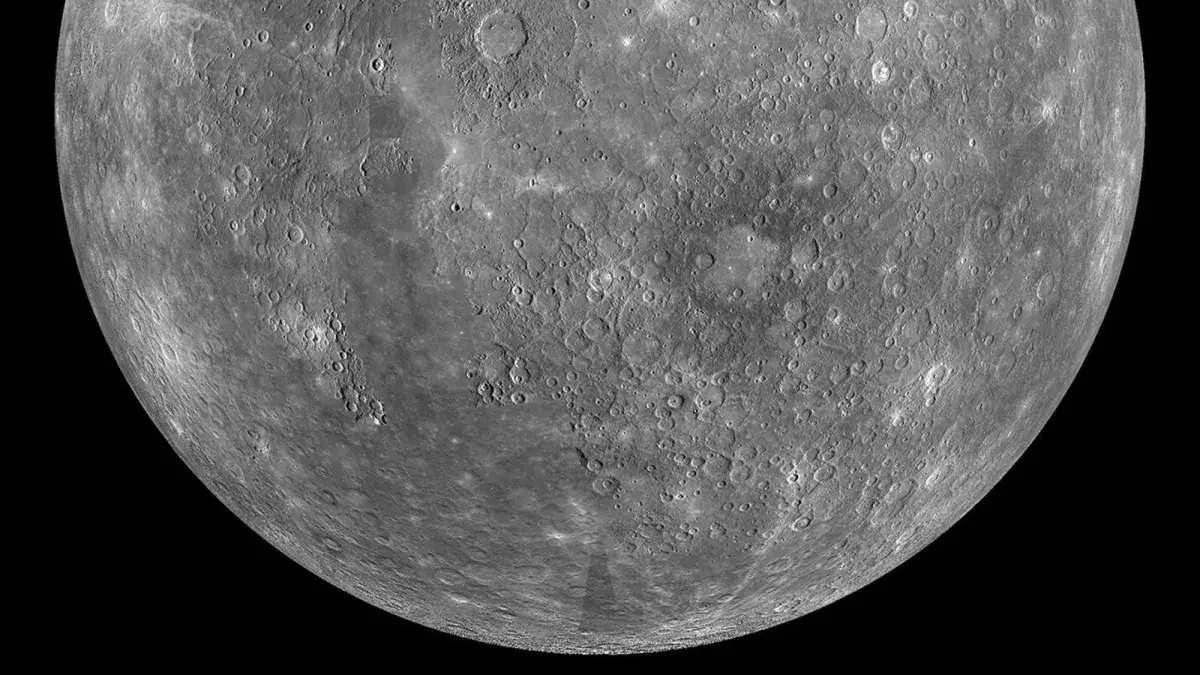
The James Webb Space Telescope has just crossed a new frontier. For the first time, it has directly characterized the surface of a rocky exoplanet, without relying on atmospheric analysis. The target: LHS 3844 b, a super-Earth located 50 light-years away from us. What JWST found there is far from hospitable. A dark, scorching rock, devoid of atmosphere. A giant Moon, orbiting a cold star.
~50 ly Distance of LHS 3844 b from Earth
+30% Larger than Earth in radius
~725°C Temperature of the day side, permanently exposed
1st time Direct study of the surface of a rocky exoplanet
LHS 3844 b: What We Knew Before JWST
A Super-Earth Locked to Its Star
LHS 3844 b orbits a cold red dwarf star, with an orbital period of just 11 hours. This extreme proximity has an immediate consequence: the planet is in synchronous rotation, just like our Moon is with Earth. One side is therefore perpetually facing the star, while the other is in permanent darkness and near absolute zero cold.
Before JWST's new observations, astronomers already had clues. Data from the Spitzer Space Telescope suggested a dark surface and the absence of a thick atmosphere. However, Spitzer could not go further. JWST's sensitivity, particularly with its MIRI instrument, radically changes what can be measured.
What is a Super-Earth?
A super-Earth is a rocky planet more massive than Earth but less massive than a gas giant like Neptune. They are among the most common types of planets in our galaxy. Some may have oceans, an atmosphere, or conditions favorable to life. However, many, like LHS 3844 b, turn out to be hostile, scorching, and barren worlds.
What JWST Measured: A World First
Reading the Heat of a Surface 50 Light-Years Away
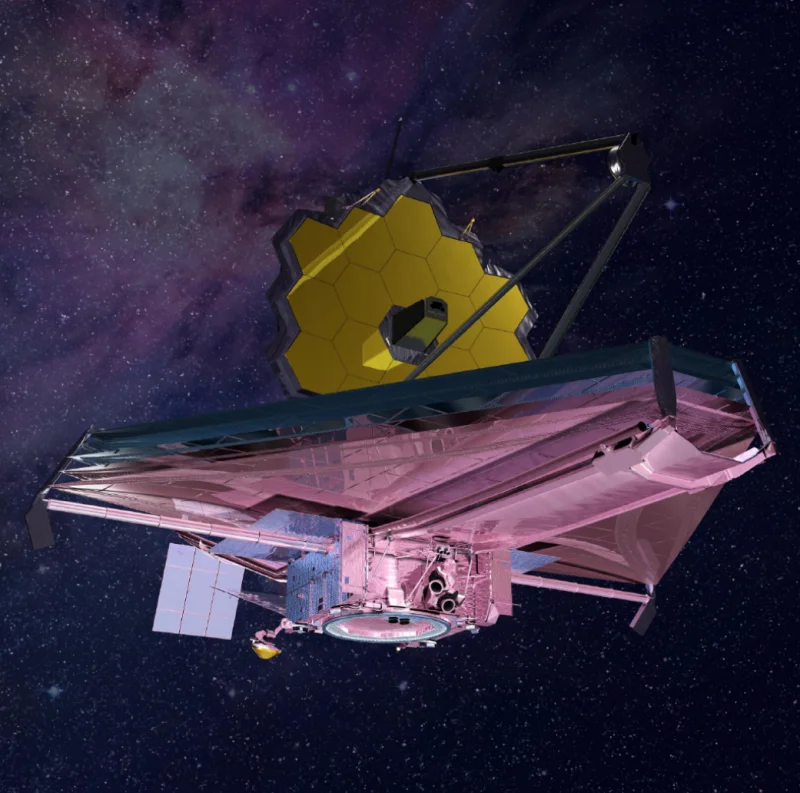
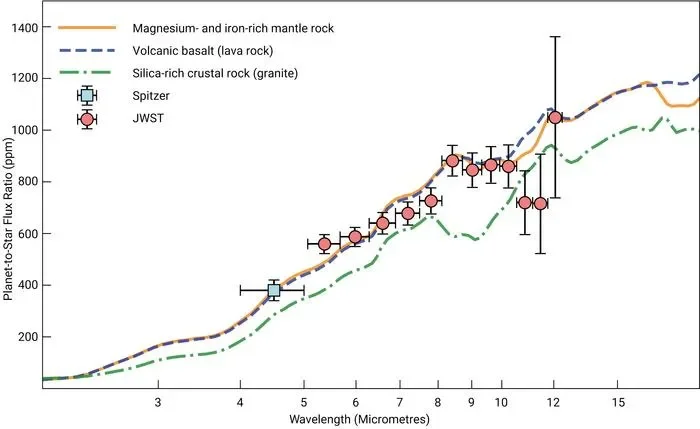
The technique used is called secondary eclipse. When LHS 3844 b passes behind its star, the combined light of the system decreases slightly. By subtracting the light from the star alone, the contribution of the planet is obtained. This faint signal, in the mid-infrared, carries the thermal signature of the surface.
JWST measured this signal with MIRI over several successive eclipses. By analyzing how the heat is distributed and at what wavelengths, astronomers were able to constrain the surface composition. The result is unequivocal: the surface is dark, strongly absorbing stellar radiation, and corresponds to basalt, like Earth's ocean floors or the surface of the Moon. No crust of light silicates like those on Earth's continents is detected.
"Thanks to JWST's extraordinary sensitivity, we can detect light coming directly from the surface of this distant rocky planet. We see a dark, hot, arid rock, devoid of any atmosphere."
Laura Kreidberg, Max Planck Institute for Astronomy, Principal Investigator
Why the Absence of Atmosphere is a Strong Conclusion
If LHS 3844 b had an atmosphere, even a thin one, it would redistribute heat between the day side and the night side. We would then observe a lower thermal contrast between the two hemispheres. This is not what JWST measured. The day side is scorching at about 725°C, while the night side is near absolute zero. This stark difference confirms that no significant atmosphere redistributes the heat.
Furthermore, no volcanic gases, such as sulfur dioxide or water vapor, have been detected. Even moderate volcanic activity could maintain a thin atmosphere. The absence of any atmospheric signal reinforces the conclusion: LHS 3844 b is a barren world, directly exposed to cosmic radiation and energetic particles from its star.
A New Discipline: Exoplanet Geology
From Atmosphere Type to Rock Type
This result opens a new scientific territory. Until now, the study of exoplanets through transmission spectroscopy involved analyzing their atmosphere, when they had one. With LHS 3844 b, JWST proves that it is possible to discuss surface composition for a planet 50 light-years away. This is exoplanetary geology, a discipline that did not exist just a few years ago.
The distinction between basalt and silicate crust is not trivial. On Earth, both types coexist: ocean floors are basaltic, while continents are rich in light silicates. This segregation results from billions of years of plate tectonics, partial melting of the mantle, and crustal recycling. LHS 3844 b, with its entirely basaltic surface, resembles a geologically frozen planet or an object without tectonic history. Closer to a large Moon than a second Earth.
What This Changes for the Search for Habitable Planets
LHS 3844 b is not a candidate for life. However, the technique developed to study it can be applied to more promising targets. Indeed, if JWST can constrain the surface composition of a rocky planet without an atmosphere 50 light-years away, it can do the same for planets located in the habitable zone of their star. Thus, we can determine whether these worlds have active geology, a differentiated crust, and conditions that could allow the presence of liquid water on the surface. LHS 3844 b is the first page of a new chapter in astronomy.