
3I/ATLAS: The Third Interstellar Comet Traverses Our Solar System - Space Tales
3I/ATLAS is the third interstellar object ever discovered. Detected on July 1, 2025, by the ATLAS telescope in Chile, it traverses our Solar System as a visitor from afar.
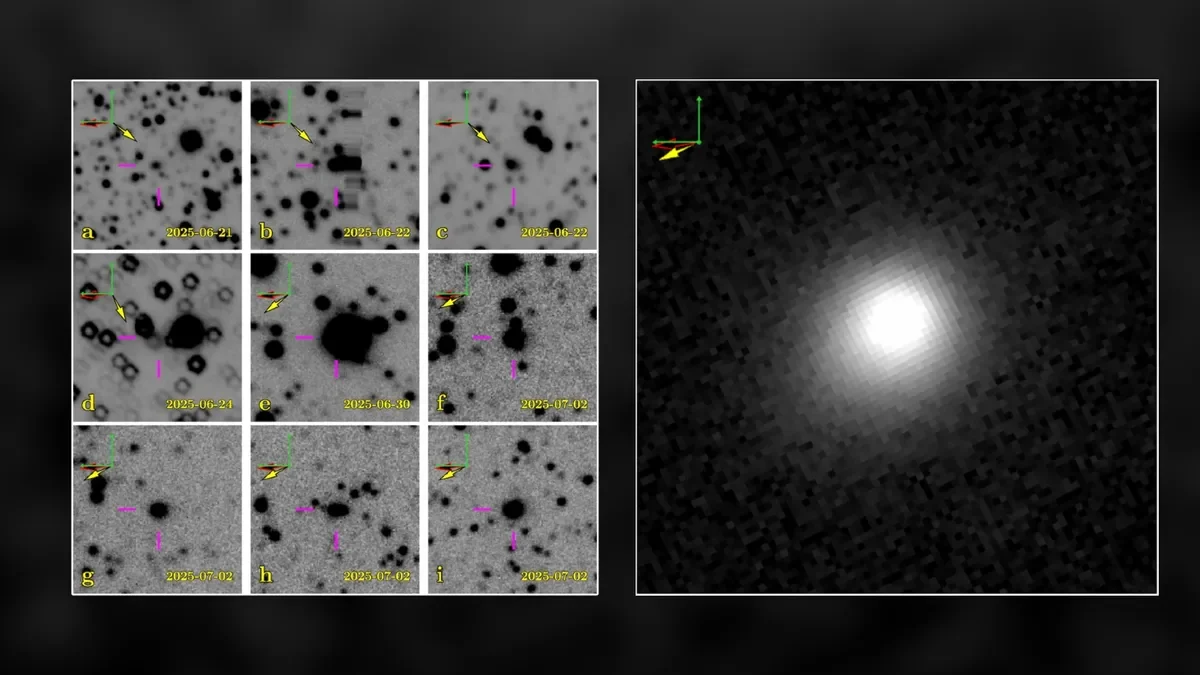
On July 1, 2025, a telescope in Chile spotted an object unlike anything familiar in our Solar System. Its trajectory is hyperbolic, its speed too high for it to be from here. 3I/ATLAS is the third interstellar object ever discovered, following ʻOumuamua in 2017 and 2I/Borisov in 2019. A visitor from another star, passing through our neighborhood and heading back into the darkness.
The Discovery: A Telescope, An Impossible Trajectory
ATLAS in Chile, July 1, 2025
The ATLAS (Asteroid Terrestrial-impact Last Alert System) telescope network scans the sky every night for asteroids that could threaten Earth. It was one of its instruments in Chile that detected 3I/ATLAS. The object was immediately flagged: its trajectory did not match that of a body from the Solar System. It is hyperbolic, meaning the object is not gravitationally bound to the Sun and will never return.
After the official discovery, astronomers scoured the archives. They found images of 3I/ATLAS in data from other ATLAS instruments and the Zwicky Transient Facility, dating back to June 14, 2025. The object was there, recorded, without anyone identifying it yet. These "pre-discoveries" allowed for a more precise trajectory reconstruction and refined orbital calculations.
Why "interstellar" and not just "comet"?
A regular comet orbits the Sun on an elliptical or parabolic trajectory. It comes from the Solar System and remains gravitationally bound to it. An interstellar object has a hyperbolic trajectory: it arrives from another star with a speed such that solar gravity cannot capture it. It passes by, leaves, and will never return. The nomenclature "I" (for Interstellar) distinguishes it from classical comets.
The Three Known Interstellar Visitors
1I
ʻOumuamua
Discovered in October 2017
First confirmed interstellar object. Atypical elongated shape, absence of cometary tail, unexplained acceleration. Sparked intense scientific debates about its exact nature.
2I
Borisov
Discovered in August 2019
First clearly cometary interstellar object, with a visible tail. Its composition turned out to be very similar to comets from our own Solar System, suggesting universal chemistry.
3I
ATLAS
Discovered on July 1, 2025
Third known interstellar object. Detected by the ATLAS network in Chile. Pre-discovery images found dating back to June 14, 2025. Observed by Hubble, several NASA missions, and the Gemini North telescope.
What Observations Have Revealed
An Object Followed by an Armada of Telescopes
After the discovery on July 1, astronomers mobilized their best instruments. The Gemini North telescope, funded by the NSF, observed it shortly after the announcement. NASA then shared images obtained by several of its missions, showing the object in different wavelengths. Hubble also turned its gaze toward 3I/ATLAS, providing images of unprecedented resolution from the ground.
3I/ATLAS behaves like a comet: it develops a coma and even a tail due to solar heat sublimating its surface ices. This distinguishes it from ʻOumuamua, which exhibited no cometary activity. In this respect, it is more similar to 2I/Borisov. However, its exact composition, stellar origin, and size are still under analysis.
June 14, 2025 First images, not yet identified 3I/ATLAS is captured by ATLAS archives and the Zwicky Transient Facility, without anyone identifying it as interstellar yet.
July 1, 2025 Official discovery by ATLAS in Chile The hyperbolic trajectory is identified. The object is flagged as interstellar and receives the designation 3I/ATLAS.
July 2025 Multi-instrument observations Gemini North, Hubble, and several NASA missions observe it. Pre-discovery images are found in the archives, refining the calculated trajectory.
January 2026 New images published NASA shares new images of 3I/ATLAS in transit through the Solar System. The object continues its path and gradually moves away from the Sun.
Where Does It Come From? Where Is It Going?
The question of the origin of 3I/ATLAS is difficult to resolve precisely. One can calculate its trajectory in reverse to estimate the direction from which it comes, but errors accumulate over millions of years and interstellar distances. What is known: it comes from outside the Solar System, at a speed incompatible with a local origin. It likely comes from another star, perhaps ejected during the formation of another planetary system.
After its closest approach to the Sun, 3I/ATLAS heads back into interstellar space. It will never return. In a few years, it will be too far away to be observed from Earth. The observation window is limited, and every piece of data collected now counts.
Why discover three interstellar objects in less than ten years?
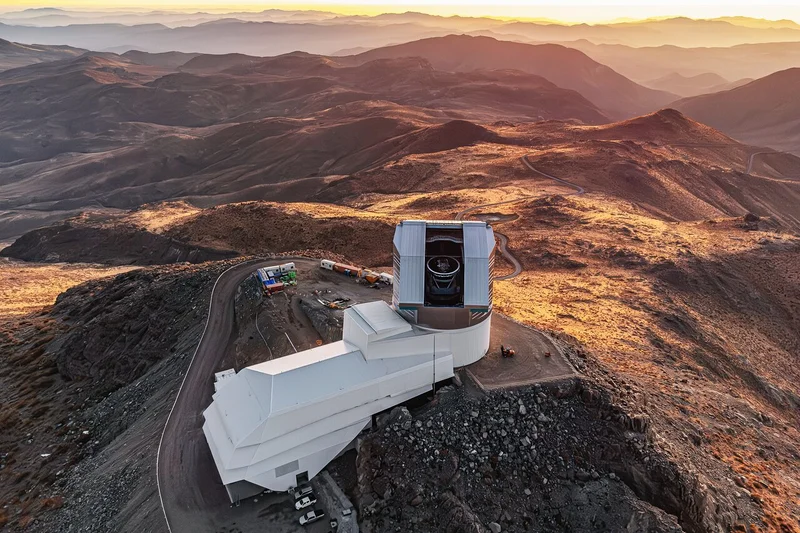
It's not that the cosmos has suddenly become more active. It's that our telescopes have become much better at detecting faint and fast-moving objects. ATLAS, the Zwicky Transient Facility, and soon the LSST of the Rubin Observatory are sweeping the sky with unprecedented cadence and sensitivity. ʻOumuamua would likely have gone unnoticed two decades earlier. The question is no longer "do these objects exist?" but "how many will we detect in the coming years?"