
990 horsepower, driverless: the autonomous Nürburgring of the Xiaomi YU7 GT
The Xiaomi YU7 GT electric SUV completed a full lap of the Nürburgring Nordschleife without anyone at the wheel, in 10 minutes and 29.483 seconds. A first in the history of the German circuit, although NIO had already achieved the feat on another track in 2017.
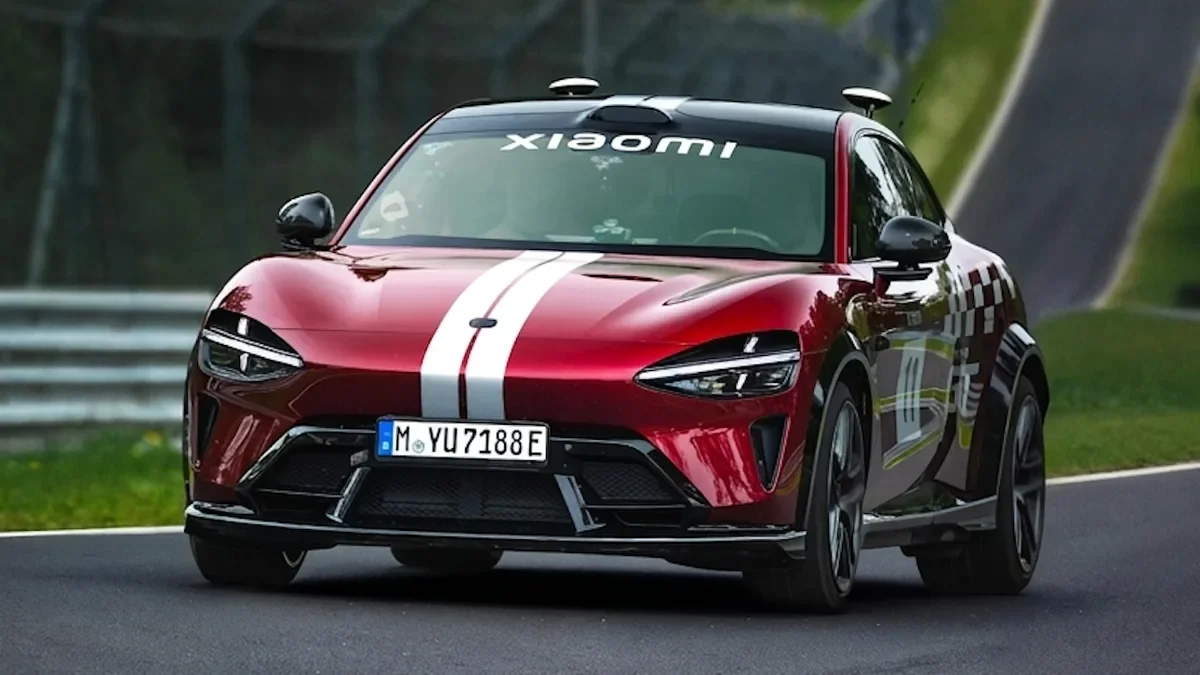
The Nürburgring Nordschleife, affectionately nicknamed "The Green Hell," is one of the most feared and respected circuits in the world. Its 20.8 km layout, with over 73 officially recorded turns and impressive elevation changes, makes it the playground of choice for manufacturers looking to prove the worth of their cars against the harshest realities of the asphalt. In this particular context, Xiaomi has just inscribed a new name in the annals of the circuit: that of an electric SUV that completed the entire northern track without any human being behind the wheel.
The displayed time, 10 minutes and 29.483 seconds, would bring a smile in any other context. But here, this time is not meant to compete with the best absolute times. It marks a first category: that of the first officially certified autonomous lap in the history of the Nürburgring.
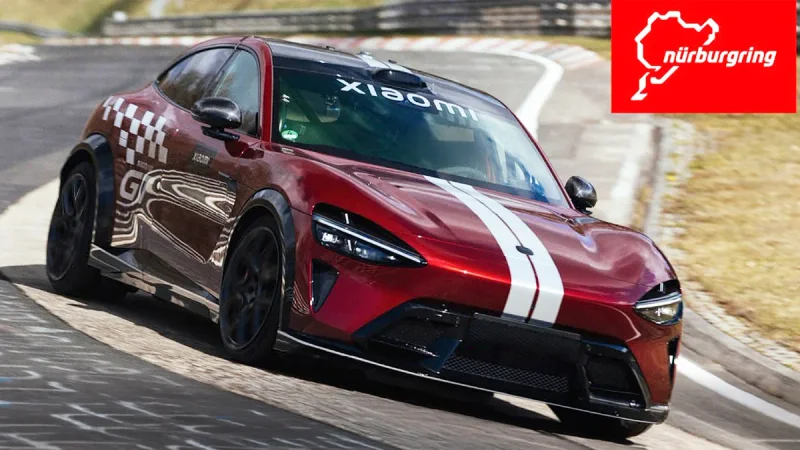
A historic lap for the German circuit
Xiaomi announced the record last Monday via its Weibo account, the Chinese social network. The manufacturer, better known until recently for its smartphones, confirms that the YU7 GT equipped with the Track Package completed the entire Nordschleife in fully autonomous mode. The Nürburgring itself relayed the information and published a video of the lap on its YouTube channel, where the empty cabin of the SUV can clearly be seen negotiating the sequence of turns without human intervention.
Watching this video is to observe a machine facing one of the most complex challenges for an autonomous driving system. The Nordschleife is fraught with traps: blind crests, deceptive slopes, brutal accelerations and braking, and a constantly changing topography. The YU7 GT responds with caution. The onboard videos show a car that approaches turns with comfortable margins, far from the physical limit, prioritizing safety over raw performance. The behavior resembles that of a novice but attentive driver, aware that even a minor incident against a guardrail would create a disastrous image for the brand.
Where the machine compensates is on the exits of curves and the straights. With 990 horsepower from a dual-motor powertrain and a 897-volt system with silicon carbide, the YU7 GT propels its 101.7 kWh batteries with remarkable efficiency. The instant electric torque allows for violent accelerations as soon as the trajectory clears, partially compensating for the seconds lost in the technical sections.
On the long straight of Döttinger Höhe, measuring 2.1 km, the YU7 GT, however, hit an artificial limit: a cap at 210 km/h. The video clearly shows the car reaching this threshold and remaining fixed at this speed, even though its mechanical potential would allow it to go well beyond. Xiaomi claims a top speed of 300 km/h for the driven version. Without this limiter, the final time would likely have been at least a few seconds lower.
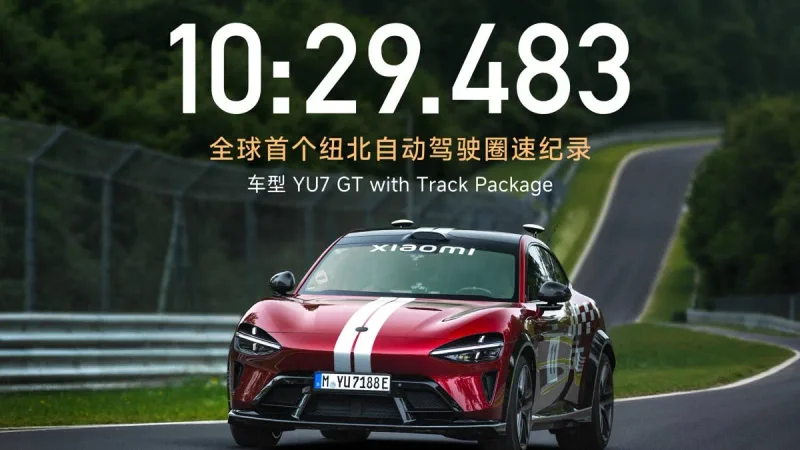
A formidable machine, a still cautious autonomous system
To understand the gap between this autonomous lap and the car's real capabilities, one must look back at what the YU7 GT accomplished just a few weeks ago with a professional driver. At the end of May, Xiaomi announced that the same SUV had completed the Nordschleife in 7 minutes and 22.755 seconds, establishing itself as the fastest SUV in the history of the circuit. This time surpassed the previous record held by an Audi RS Q8 Performance, set in the autumn of 2024, by nearly 14 seconds.
The gap between the two performances, over three minutes, concretely illustrates the current state of high-performance autonomous driving. The system onboard the YU7 GT for this driverless lap is likely not the same as that used daily on Chinese roads. Carscoops raises the question of what precise data allowed the car to know where to brake, where to accelerate, and how to anticipate each sequence of the track. A standard Lidar designed for urban traffic is not sufficient to navigate at 210 km/h in the fast sections of a racing circuit. The preparation in advance, whether it involves high-precision mapping or circuit-specific calibration, certainly played a central role in the success of this lap.
The YU7 GT also boasts impressive technical specifications on paper. Xiaomi claims a sprint from 0 to 100 km/h in 2.92 seconds and a range of up to 438 km according to the CLTC measurement cycle used in China. High-power charging, enabled by the 897-volt architecture, would allow adding the equivalent of 354 km of range in just 15 minutes under optimal conditions. A specific cooling system has also been developed to withstand the thermal demands of fast track laps, whether a human or an artificial intelligence is at the controls.
The aesthetics of the SUV have not failed to fuel comparisons with the Ferrari Purosangue, from which it shares some general lines. Xiaomi does not really deny this and embraces a silhouette clearly inspired by the high-end European sports SUV segment.
NIO paved the way in 2017
While Xiaomi can legitimately boast a first at the Nürburgring, the brand cannot claim a world first in the category of autonomous laps on a circuit. This title belongs to NIO, another Chinese electric manufacturer, which achieved the feat nearly a decade earlier.
In 2017, NIO sent its electric hypercar EP9 to the Circuit of the Americas in Austin, Texas, with no driver on board. The autonomous lap was timed at 2 minutes and 40.33 seconds, with peaks of around 260 km/h. This result is all the more remarkable as the EP9 had already proven its capabilities with a human driver on the same circuit, setting a production car lap record. The same model later completed a timed lap at the Nürburgring in 6 minutes and 45.9 seconds, making it one of the fastest electric vehicles of its time on the German circuit.
The NIO EP9 was not a production car: it was a hypercar prototype developed specifically to demonstrate the manufacturer's technological mastery. Xiaomi's approach with the YU7 GT is different in nature, as it is a production SUV intended for sale, with an autonomous driving system developed for use on open roads. Therefore, the two approaches are not strictly comparable, but the timeline is unambiguous.
What the YU7 GT's lap illustrates above all is the speed with which Chinese manufacturers have caught up and, in some areas, surpassed European and American standards in electric mobility and autonomous systems. In just a few years, Xiaomi has transitioned from manufacturing smartphones and consumer electronics to designing an SUV capable of beating automotive benchmarks established for decades on the world's most demanding circuit.
The YU7 GT is marketed in China. No launch date for the European market has been confirmed by Xiaomi to date.