FootyCon: A Unique Historical Football Conference Experience
Franzi and Sascha attended FootyCon in London, a significant conference for football historians, where they explored the history of women's football and engaged with various speakers.
From June 11 to 13, we—Franzi and Sascha—traveled to London to attend FootyCon, one of the largest conferences for football historians in Europe. How did this come about, and what exactly did we do there?
Since 2021, our team, Legende Verloren, has been dedicated to rediscovering the history of women's football beyond Germany. We delve into newspaper archives, old documents, and databases, and engage with individuals who have a deep understanding of football history in their respective countries.
This effort led to the creation of "Forgotten Heroines," an English-language blog where we collaborate with several partners to explore the history of women's football country by country. Scholars from Nigeria, Cameroon, Ghana, and Kenya have shared their insights on the history of women's football in their nations, while our team has documented the stories from Jamaica, Ireland, Iceland, Scotland, Malta, Austria, and Germany.
In recent years, we have particularly focused on reconstructing the histories of Jamaica, Iceland, and Hawaii. Our research yielded so much new information that we even published a scholarly article on Hawaii and Jamaica. Last year, we received an invitation to FootyCon, prompting us to apply with our topic.

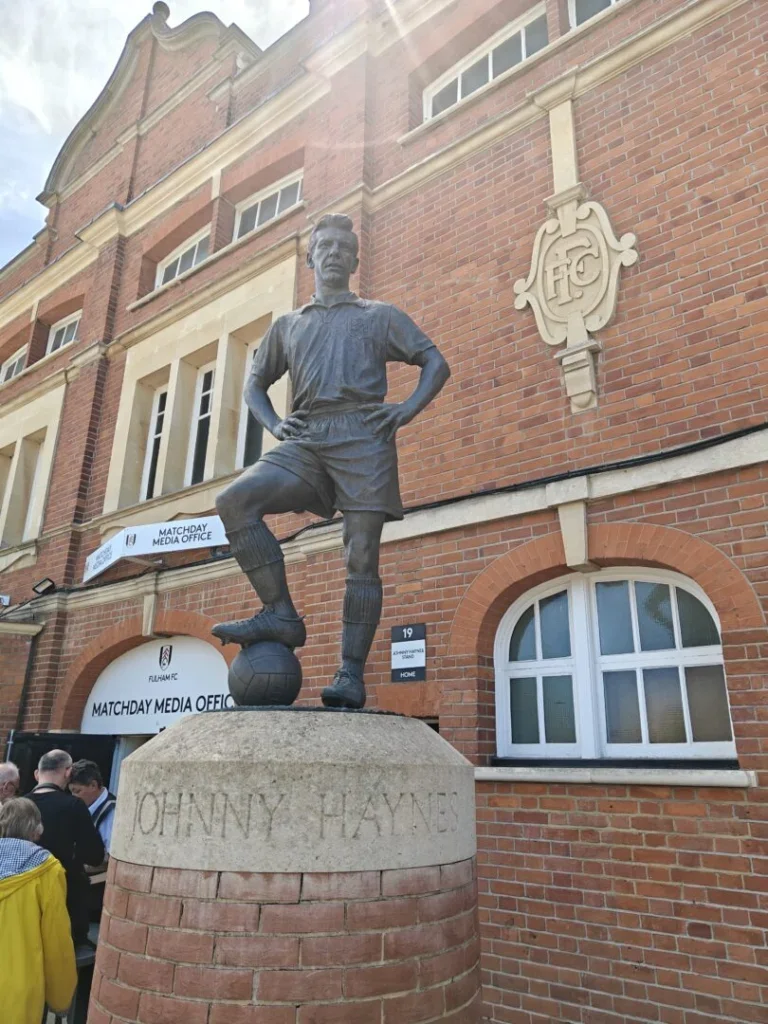
We teamed up with our partner Adam from England, who was researching Iceland, and submitted a proposal to present "Forgotten Heroines" in a one-hour panel. We secured Cassie Whittell, who works at Brighton & Hove Albion in the Premier League, as our moderator. Our proposal was accepted, and we were invited to present at Craven Cottage, home of Fulham FC.
As we boarded the train to London, we were unsure of what to expect. This was our first academic football conference, and we did not know any other attendees. However, when we were informed to dress casually, preferably in jerseys, we felt reassured that this gathering was primarily for researching fans. We left the event feeling that we had become part of this vibrant community.
The Conference and Its Speakers
Upon reviewing the conference program, we were pleasantly surprised to find that we were not alone in our focus on women's football history. For instance, Celia Valiente Fernandez from Spain discussed women's football during the Franco dictatorship, while mathematician Jess Hargreaves examined competitive balance in the English league.
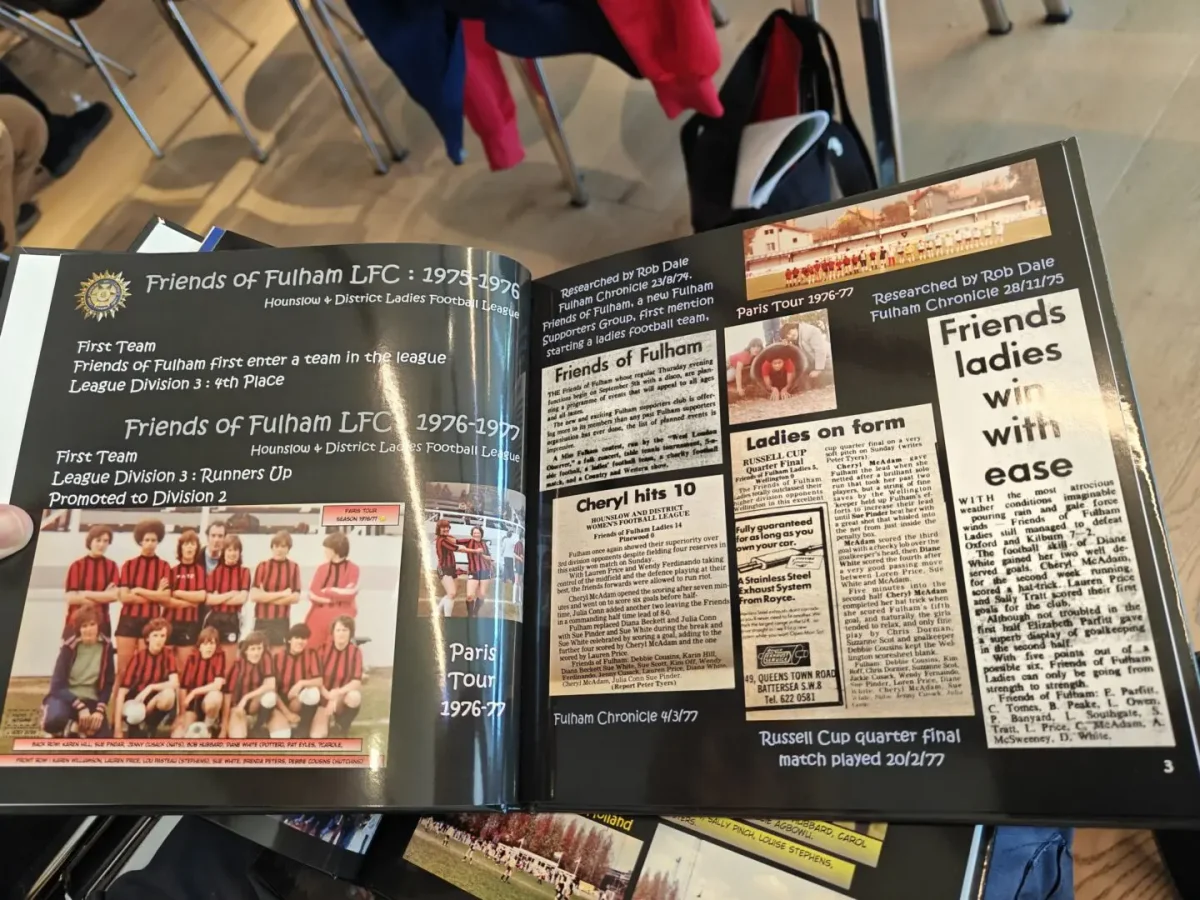
In an interview format, Patricia Gregory and former England national player Lori Hoey shared their experiences and the history of the Friends of Fulham LFC, which won the English Cup in 1958. Stuart Gibbs presented his research on the life of Lily Flexmore, a player from the legendary British Ladies FC of 1895.
The conference also stood out for its inclusion of topics beyond traditional football, featuring discussions on rugby, Gaelic, and Australian football.
Moreover, the event highlighted lesser-known aspects of football, such as the political significance of fanzines and the history of football in countries like Yugoslavia and Finland.
Football Unites, Racism Divides: Intersections Between Fanzines and 'Official' Anti-Racist Campaigns at the Local and National Level, 1994-2003 – Cameron Huggett
Cameron Huggett's presentation explored the role of football fanzines in combating racism in England from 1994 to 2003. Central to this discussion was the Football Unites, Racism Divides (FURD) initiative, founded in 1995 in Sheffield to improve access to football for Black, Asian, and minority ethnic communities following racist incidents surrounding Sheffield United games.
A 1997 study revealed that while most fans rejected racism, many individuals from these communities still felt excluded from the club. When the Sheffield Star sensationalized the study's findings, the fanzine Flashing Blade responded, serving as a corrective voice to the established press.
Starting in 2000, FURD also contributed to the publication United Colours of Football, which brought together fanzines, fan organizations, and anti-racist initiatives. Despite valid critiques regarding its limited focus on structural racism, it successfully engaged fans who were skeptical of official campaigns.
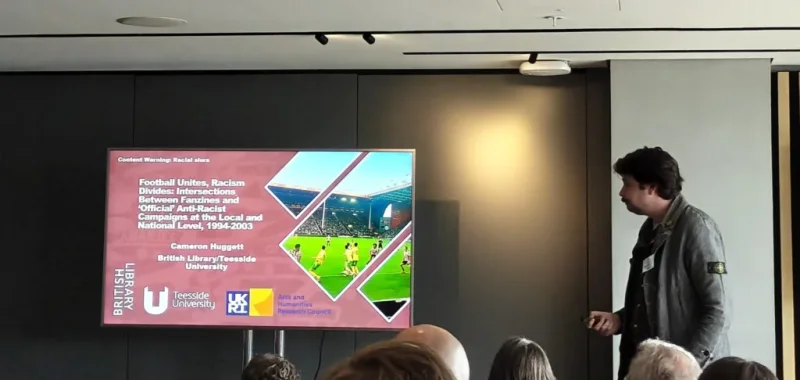
Huggett concluded that FURD became a vital model for anti-racist fan work, significantly contributing to the evolution of local initiatives into a nationwide movement in English football.
Dictatorships and Women's Football: The Case of Franco's Spain, 1939-1975 – Celia Valente
Celia Valente's presentation delved into the contradictions of women's football under the Franco dictatorship. The regime promoted a strictly Catholic image of womanhood, confining women to roles of motherhood, homemaking, and family. Physical exertion was often deemed unladylike, harmful to health, or even morally dangerous, making football—traditionally seen as a male domain—hardly compatible with these ideals.
However, Valente argued that the history of women's football cannot be reduced to a simple ban. State institutions, the Catholic Church, and the male-dominated sports world collaborated to restrict women's access to football and render their athletic activities invisible. Yet, there were also spaces for resistance: individual women could participate in sports as long as it aligned with traditional notions of femininity.
It wasn't until the regime weakened in the late years that women's teams and competitions began to reemerge around 1970, largely without support from the Spanish Football Federation. Valente's talk highlighted how dictatorships shape women's football not only through formal prohibitions but also through societal norms, institutional neglect, and the deliberate crafting of historical invisibility.
Mind the Gap: Investigating Competitive Balance in the Women’s Super League – Jess Hargreaves
Jess Hargreaves focused on a significant challenge facing the Women's Super League (WSL): the substantial competitive gap between top clubs and the rest of the league. Although the WSL has experienced significant growth and professionalization in recent years, many matches remain lopsided. High win rates for favorites, large goal differences, and relatively few draws indicate that true competitive balance is still the exception.
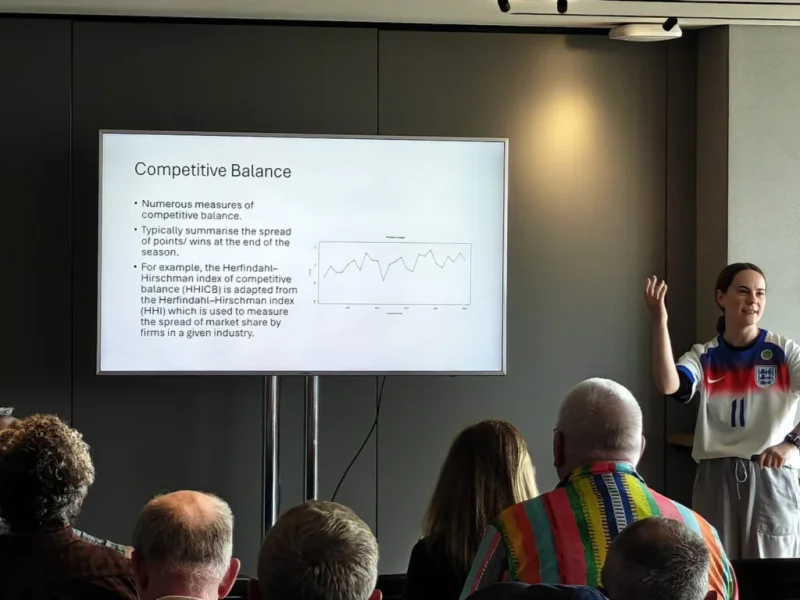
Hargreaves raised an intriguing question: does this lack of tension affect audience interest? The findings suggest that in England, the relationship is not straightforward. The perceived competitiveness of a match only slightly influences viewer numbers; factors like the quality and recognition of the teams involved, the significance of the match for the title race, and the venue play a more critical role. Matches in larger stadiums attract significantly more fans, while midweek games and long travel distances tend to deter attendance.
Thus, Hargreaves challenged the common assumption that a more appealing league is created solely by closer results. Despite this, the lack of competitive balance remains a structural issue, as many matches hold little significance for championships, European qualification, or relegation. The pressing question is how investments, talent, and visibility can be distributed more evenly across the league.
HatTrick Instead of Heysel: History of European Men’s Elite Football Since the 1980s from the Perspective of Finland – Sami Koskelainen
For Forgotten Heroines, we have long sought an expert to address the history of Finnish women's football. We have yet to find the right expertise for this task. Therefore, we found Sami Koskelainen's talk particularly exciting, as it focused solely on professional men’s football while adopting a perspective familiar to our research in women’s football.
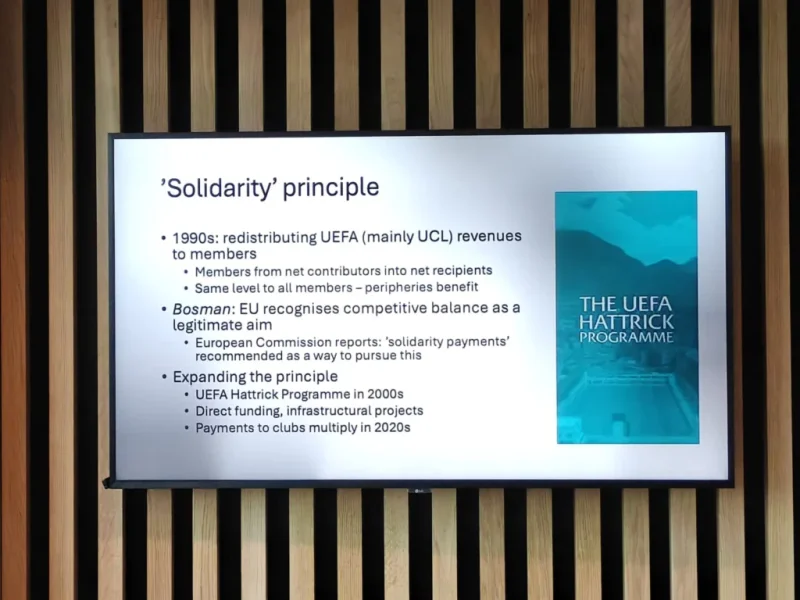
The talk centered on how the history of European football is typically narrated—focusing on professionalization, court decisions, and developments in England, Scotland, or Central Europe. For Finland, a smaller football nation on the periphery of this dominant narrative, these historical milestones resonate only partially. The so-called "history of European football" does not align with Finnish experiences.
Koskelainen's presentation proposed alternative historical reference points and posed a fundamental question: How European is a European football history that is so heavily centered on the British Isles and Central Europe? This inquiry is particularly relevant for the broader understanding of football history as it seeks to include diverse narratives from across the continent.