
March Seedlings in the Vegetable Garden | Terra Potager
The month of March awakens nature and offers the opportunity to start many sowings. However, winter still resists, and the risk of frost is not over. Discover which crops can be sown this month.
- Learn to harvest all year round
- Shop
- Our calendar/almanac
- Our ACD greenhouses
- The vegetable garden review
- Order seeds
- Gardening products, fertilizers
- Online course ‘I succeed with my tomatoes’
- Vegetable garden tips
- Themes
- Successfully sowing and planting
- Soil: amendments, fertilizers, compost
- Vegetable gardening techniques
- Pests in the vegetable garden
- Growing vegetables
- Flowers, aromatic and medicinal plants, biodiversity
- Connect
- Contact
Select a page
- Learn to harvest all year round
- Shop
- Our calendar/almanac
- Our ACD greenhouses
- The vegetable garden review
- Order seeds
- Gardening products, fertilizers
- Online course ‘I succeed with my tomatoes’
- Vegetable garden tips
- Themes
- Successfully sowing and planting
- Soil: amendments, fertilizers, compost
- Vegetable gardening techniques
- Pests in the vegetable garden
- Growing vegetables
- Flowers, aromatic and medicinal plants, biodiversity
- Connect
- Contact
Currently, 10% off your order at our partner Comptoir des jardins. More information
Do you want to learn how to grow your own vegetables? With the Terra almanac, you won’t forget any sowing: just open your file, look at the current month, and you have all the sowings to be done (explained in detail), which will allow you to produce vegetables all year round.
Click here to learn more and take advantage of our launch offer valid right now!
The month of March awakens nature and offers us the opportunity to start many sowings. But be careful, winter is still holding on. The risk of frost is not over. That’s why it’s out of the question to sow certain crops directly in the ground. Nevertheless, many crops know how to brave the cold and are satisfied with the first mildness of spring that is coming. Others can start to be sown under cover to be planted in the vegetable garden in May. Let’s look at all this in detail to properly kick off the season.
Summary
- Sow tomatoes at the end of the month
- Eggplants and peppers
- Peas
- Fava beans: let’s go!
- Sow Swiss chard and beets in March
- Sow more lettuce
- Planting alliums
- Sow spinach
- Don’t forget the radishes
- Potatoes
- Mesclun
- Among others…
Sow Tomatoes at the End of the Month
Tomatoes, which every gardener eagerly awaits, can be sown in March, but absolutely under cover. Like all summer crops, they do not tolerate frost. Here, I sow them in trays, one seed every centimeter in all directions. The tray is simply placed indoors so that the sowing has a nice temperature around 20°. As soon as germination occurs, caution is needed! It is essential to provide maximum light; otherwise, your little plants will become leggy and eventually die. Expose your tray to full sunlight, behind a window, or under a veranda. Take it outside when it’s mild, around 15°. If you have a greenhouse, set the tray there, but bring it inside at night if frost is forecast. Once the plants are 5 cm tall, you can transplant them into individual pots, always prioritizing maximum light. In May, it’s time to plant them in the ground after the last frost risk.
For other summer crops like melon, watermelon, corn, cucumber, zucchini, squash, sunflower, beans… I recommend waiting until April to sow your seeds in pots under cover. These sowings are quick. They take just 4 to 5 weeks to develop. For planting in May, April is therefore sufficient for sowing. If you have the chance to grow under a greenhouse, advance these sowings to this month of March.
Eggplants and Peppers
Another sowing of summer crops is recommended in March, if you haven’t already done it in February, that of eggplants, peppers, and chilies. We group these 3 sowings together as they have the same needs and the same mode of operation. They take a long time to produce good plants, even more than tomatoes, over two months.
Unless you provide them with maximum temperature (25°) and light (LED, grow lights). In any case, March is still a good time to start and succeed with these 3 sowings. Sow in trays like for tomatoes. Then place these trays in a warm spot. Several solutions are available, such as placing the tray near a fireplace, a radiator, under a mini greenhouse behind a south-facing window, or under a veranda. Or you can set the sowing on a small heating mat. Over the years, I have gradually equipped myself, and it’s on a heating mat that these sowings work best.
It consumes 10w per hour, which means just a few cents a day in electricity. I accept this expense for my passion for sowing. Once germinated, always the same priority, light everywhere! Ideally, place your plants under supplemental lights. LED lamps turned on for 12 hours a day will help your plants grow vigorously. But nothing is mandatory; without that, expose your plants to as much sunlight as possible. They will just take a few more weeks to develop. But by the end of May at the latest, you will have beautiful plants to plant in the vegetable garden.
Now let’s look at the many sowings you can start this March that do not require too much heat or light.
Peas
Snow peas and garden peas can be sown directly in the ground. However, be cautious in cooler climates. Sometimes you have soil that is almost frozen from a harsh winter, or it can be too wet. Wait until April, or otherwise, aerate, loosen the soil and sow under a mini tunnel. Another option is to sow some seeds in pots under cover, 5 to 6 seeds per 7x7cm pot. In other climates, go ahead and sow freely in the ground. Here in the south, hundreds of seeds are already in the ground with soil well-moistened from recent rains without being waterlogged. You can spread these sowings over several weeks until May to further stagger your harvests. Be careful, these crops hate heat, so don’t delay sowing in the hottest climates.
Fava Beans: Let’s Go!
Fava beans can be sown as soon as the soil warms up to around 10° during the day. The sowing can withstand frost, at least light frosts down to -5°. If strong negative temperatures are still to be feared in your area, wait until April. Otherwise, sow this March, one seed every 10 cm. Here, the fava beans sown in the fall should have allowed for early harvests this spring. Usually, the crop germinates in late autumn and survives the winter without issue to resume growth in March. However, severe and repeated frosts have dashed hopes for early harvests. So I am doubling my sowings this March to harvest this vegetable that we appreciate so much. Fresh fava beans, raw, just harvested, are a little joy to munch on.
Sow Swiss Chard and Beets in March
Swiss chard and beets are two crops that are very interesting to grow in mid-season. They do not require the heat of summer crops and, on the contrary, are satisfied with temperatures between 15 and 20°. Therefore, you can already prepare the plants under cover to transplant them in April. Sow one seed (more precisely, a cluster for these crops) per pot. Each cluster gives you 2 to 3 plants. You can keep just one or let them all grow. You will then have clusters of beets or Swiss chard for each pot transplanted into the ground. Here, I leave the pots in the greenhouse, even for the germination phase. The warmth in the greenhouse in March is sufficient for this sowing, which also knows how to withstand light frosts. Otherwise, you can bring them inside, but that involves a lot of handling. There’s also the option of sowing in cell trays for easy handling of your sowing, transferring it from the house to the outside if needed.
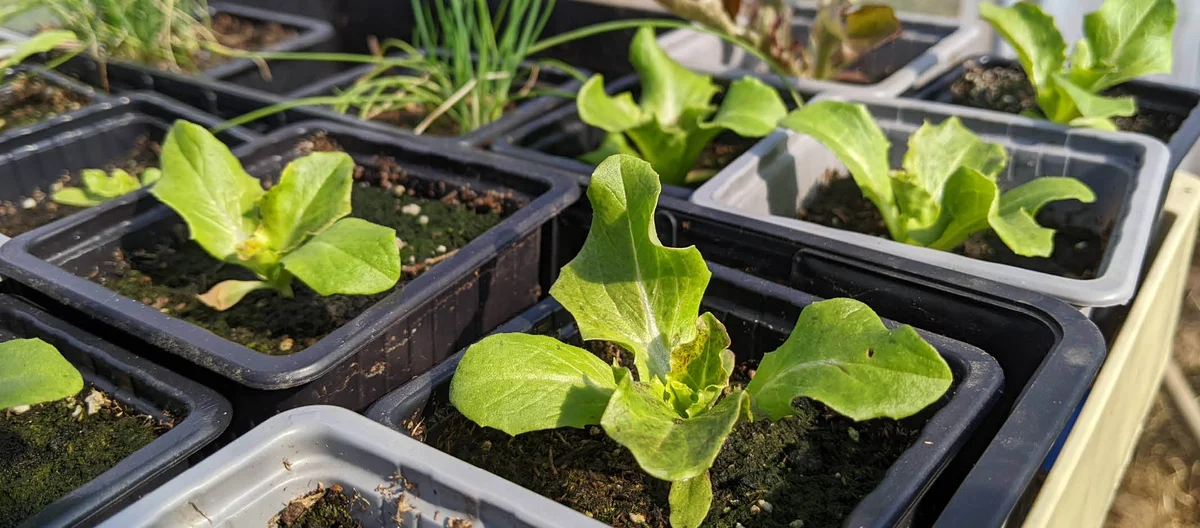
Sow More Lettuce
Lettuce can be sown almost all year round! March is no exception. Here, it’s already a second sowing launched after a first in January. Generally, I sow lettuce again when the previous sowing is planted in the ground. This has been done with the first plants already installed in the ground from a sowing on January 20. So it’s a second sowing that is launched in March. A third will come in April before resuming sowings after summer, a period when we do not consume salad in favor of the many other harvests that the vegetable garden offers us. Sow in trays, and unlike summer sowings, be careful with excess heat! Lettuce sowing hates it, especially after germination. Install your sowing, if possible, under a cold frame outside.
Planting Alliums
For onion, shallot, and garlic crops, it’s getting late to do your sowings. They take a long time to develop, over two months. But… it’s still possible for planting in May and harvesting in late summer. Don’t delay. The best is to plant these crops from bulbs that you can find in garden centers or online. An onion bulb ultimately gives you a large onion. For shallots and garlic, you find cloves to plant, which will multiply. One planted clove gives you 5 or 6 to harvest. Here, my onion and shallot sowing from January is not yet ready to plant. It’s long! But I am patient while planting some bulbs that I have on hand in the meantime. These crops withstand frost, so there’s no problem planting all this in the ground even if it frosts until mid-April.
Sow Spinach
Spinach can be sown freely outdoors in the mildest climates. It’s another crop that is satisfied with little heat, loves moisture, and conversely hates heat and dryness. Harvests ideally occur throughout spring and then in autumn, even during winter in mild climates. If it’s very cold and too wet, you can sow some of your seeds in containers under cover. However, avoid sowing in trays, which is not suitable for this crop. Prefer sowing in small pots or even better, in cell trays. 3 seeds per small cell of just 3cm in diameter, and within 10 days, you will have beautiful germination. A month later, you can transplant your clumps into the ground. Be careful with watering; here, I missed a first sowing by overwatering the potting soil. Water to keep the potting soil just moist like a wrung-out sponge.
Don’t Forget the Radishes
March is also the beginning of the full season for radish sowing. The days are getting longer, temperatures are rising, and this creates a context that prevents them from bolting too much, producing large foliage without roots, and ultimately no radishes. Avoid sowing under cover or in shallow trays like fish trays. Some radishes may thrive there. But sowing directly in the ground is highly recommended, even if it means adding a small tunnel if you lack warmth. If...