Starting a Vegetable Garden | Terra Potager
Starting a vegetable garden is often a mix of enthusiasm and doubts. This article explores the fundamental principles of gardening, from understanding your soil to watering and mulching.
- Learn to harvest all year round
- Shop
- Our calendar/almanac
- Our ACD greenhouses
- The vegetable garden review
- Order seeds
- Gardening products, fertilizers
- Online course 'I succeed with my tomatoes'
- Vegetable garden tips
- Topics
- Succeeding with your seedlings and plants
- Soil: amendments, fertilizers, compost
- Vegetable garden techniques
- Pests in the vegetable garden
- Growing vegetables
- Flowers, aromatic and medicinal plants, biodiversity
- Connect
- Contact
Currently, 10% off your order at our partner Comptoir des jardins. More information
Do you want to learn how to grow your own vegetables? With the Terra almanac, you will never forget your sowing: just open your file, look at the current month, and you will have all the sowings to be done (explained in detail), which will allow you to produce vegetables all year round.
Click here to learn more and take advantage of our launch offer currently available!
Starting a vegetable garden is often a mix of enthusiasm and doubts. I remember my first years, overflowing with passion and the desire to grow my vegetables… but also filled with so many questions. Should I work the soil? Should I put mulch everywhere? Should I add fertilizer? Compost? Install raised beds? Today, we find very assertive methods, sometimes presented as universal, if not miraculous. But in gardening, context is key: the nature of the soil, the climate, the available time, the cultivated area, the production goals… Starting a vegetable garden is not about applying a recipe. It’s about understanding a few fundamental principles to build, season after season, a fertile soil and successful crops. Let’s explore all of this in this article.
Summary
- Observe before acting: understand your soil
- The ideal soil
- Compact, clayey, rocky soil
- Sandy soil
- Impossible to cultivate soil, too rocky, fill soil, or exposed rock, balcony, terrace.
- A word on exposure:
- A word on the size of the vegetable garden
- A word on watering
- A word on mulching
- A word on fertilizers
Observe before acting: understand your soil
We all have different starting soils. There can be huge differences from one vegetable garden to another. Sometimes it’s ideal with a nice proportion of sand, silt, clay, and a good rate of decomposed organic matter (all the plant and animal life that dies and decomposes over time). Sometimes, it’s a horror with too much clay. Hello compaction as soon as it’s dry, when it rains too much, or when the mulch is lacking. Sometimes it’s too sandy, and hello to the lack of water retention and minerals. Think of the beach, so infertile. A vegetable garden that is too sandy can quickly resemble that. Sometimes too many stones, sometimes exposed rock… In short, what inequalities! But don’t panic, regardless of your context, your starting soil, you can always achieve your goals and start a vegetable garden. Let’s quickly look at these different contexts.
The ideal soil
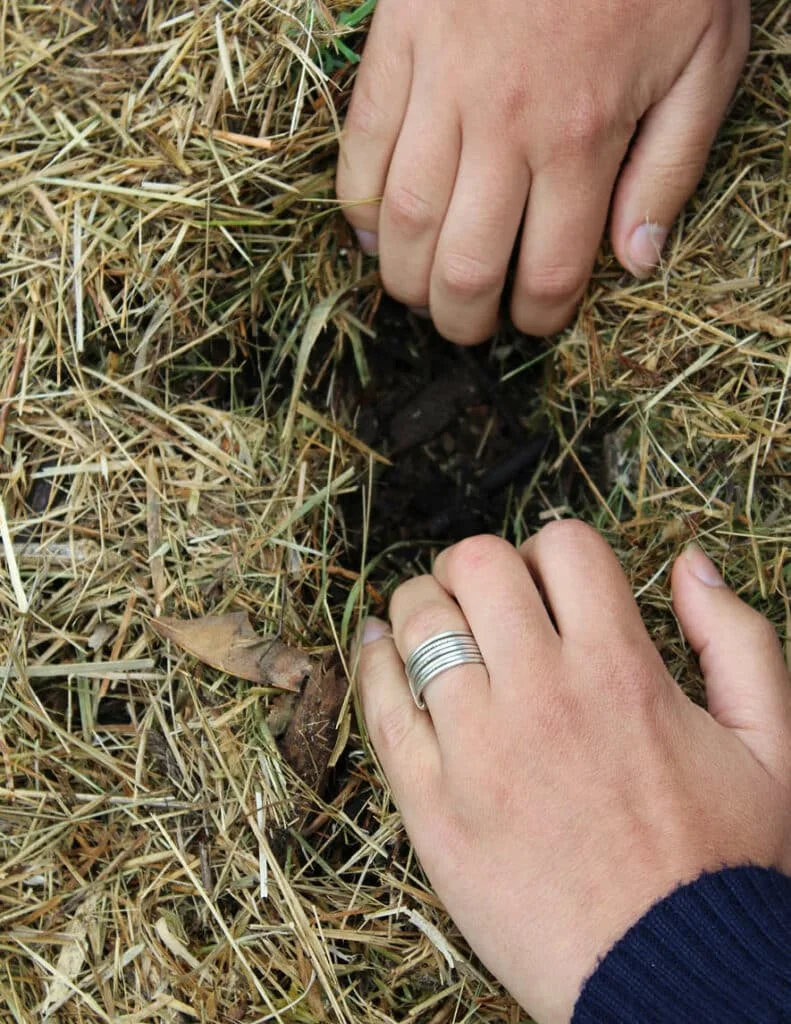
Take a clump of soil in your hand and try to make a sausage shape. If it crumbles as soon as you refine it, you have a nice soil texture. It should be sufficiently silty to stretch the sausage and sufficiently sandy to break if overworked. If this soil is also a beautiful black color, you have a wonderful garden soil in your hands!
In this case, don’t touch anything! No need to plow, rototill, dig, or hoe. Biological activity does the work for you! Just remove the surface vegetation with a hoe and a spade. Add a generous scoop of compost per square meter or a handful of organic fertilizer if compost is lacking. Incorporate everything into the top 5 to 10 centimeters. Take the opportunity to refine, weed out a few roots, and break up any clumps if needed, and you’re good to go! Let’s sow and plant to our heart’s content.
Compact, clayey, rocky soil
Is your soil good for pottery? Can the sausage in your hand be refined endlessly? The context is less idyllic.
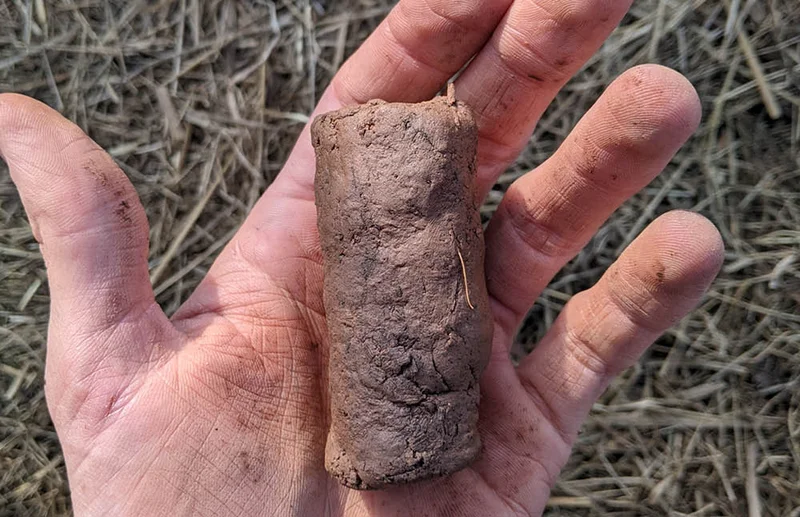
Here, you need to mechanically work your soil to make it fertile as quickly as possible. Get out the spade or pickaxe or a large rake. Work your soil to about 20 cm to break up clumps, weed, aerate, oxygenate, refine, and loosen everything. Take the opportunity to add as much composted organic matter as possible to lighten it up. Manure compost, plant compost, homemade compost, compost from professional soil companies, or even from sand pits or recycling centers. Add 3, 5, 10, or even 20 kilos per square meter if you wish. Many gardening schools encourage adding a maximum dose in the first year. After that, only 3 to 5 kilos per square meter will be needed each season, especially for nutrient-hungry crops, particularly summer ones.
Without compost, consider using organic fertilizers. However, these are less structuring and nourishing for biological activity, meaning you will need to frequently repeat mechanical soil work. Finally, you can occasionally try adding sand. But it should be coarse to avoid a "concrete" effect, with a grain size ideally between 0.5 and 2 mm. Lastly, use non-calcareous, siliceous sand for the best results.
Sandy soil
Can’t make a sausage in your hand? Does it break as soon as you mold it? You have mostly sandy soil. Great for producing potatoes, carrots, and root vegetables. But beware of water and mineral loss with soil that lacks retention. Here too, the ideal is to think in terms of organic matter and compost. Go ahead and add plenty right from the start of your vegetable garden. Soon you will have a much higher quality substrate for gardening. There are also bags of clay sold commercially. Why not, at about a kilo per square meter. But add it with organic matter to maximize its value. However, this addition is not essential. Focus primarily on organic matter.
Impossible to cultivate soil, too rocky, fill soil, or exposed rock, balcony, terrace.
If you consider your soil context impossible to cultivate or absent because you are on a balcony or terrace, you still have the option of using topsoil. This is offered by many companies. Just type "topsoil" into a search engine. This soil is an ideal mix of sand, silt, clay, and organic matter. Be careful not to confuse it with plant compost, which is 100% organic matter. With this topsoil, anything is possible! I have tried it several times. To fill raised beds, as well as to supply some open ground plots where I wanted to avoid a horrifically rocky, calcareous, compact soil. And what a pleasure, what joy to garden in such a substrate. You just need to enrich it each season with compost and/or organic fertilizers. It’s an investment, about €30 per ton, but it lasts a lifetime!
A word on exposure:
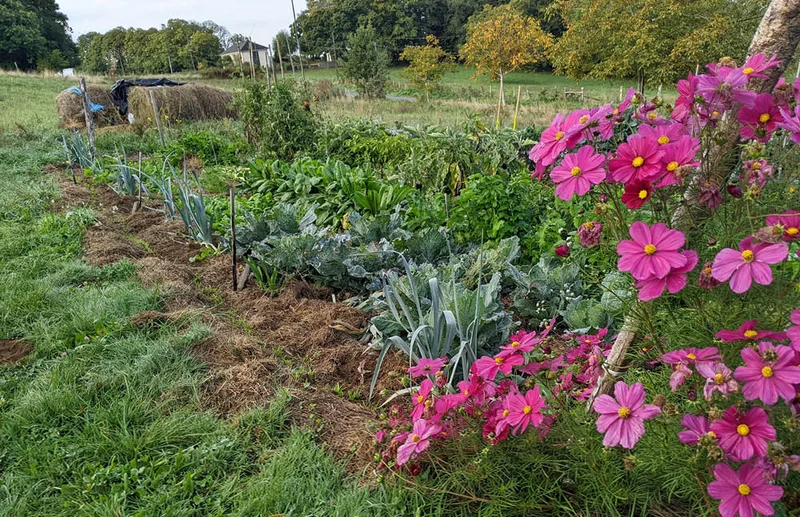
Be careful not to deprive yourself of too much light. One of the essential keys to fertility is photosynthesis. It needs at least 6 to 8 hours of sunlight per day to be optimal. Yes, in summer, you may sometimes rely on shade to avoid heatwaves, growing leafy vegetables that can get too hot. But overall, you need to seek light. Here I am lucky to have all exposures, some semi-shaded plots, and some in full sun. The latter are especially useful in mid-seasons to capture all available light. Those in semi-shade allow for successful crops during the height of summer. I think of squash that thrive in semi-shade in July and August, just like Swiss chard, beans, lettuce, beets, carrots… If you are in the northern part of the country, go for full sun at all costs, even if it means mulching in summer to best preserve soil moisture.
A word on the size of the vegetable garden
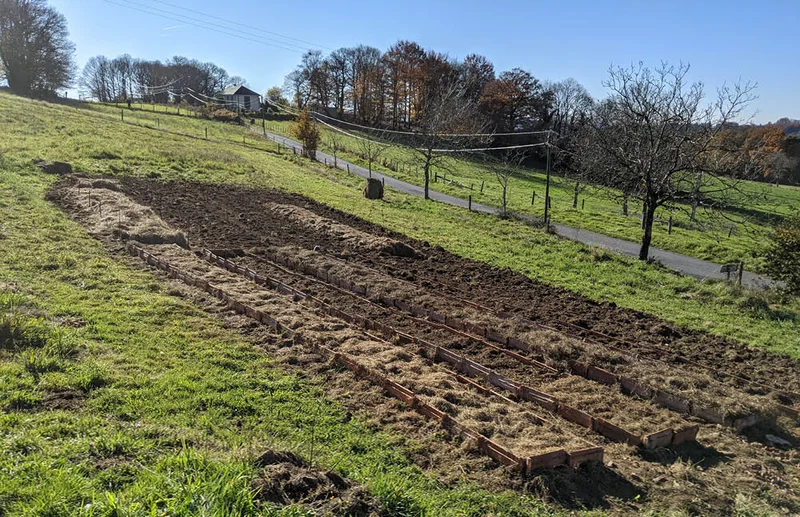
Every square meter of vegetable garden requires a minimum of attention. Watering, staking, weeding, observing, sowing, planting… You should count about 2 to 3 minutes per day for 10 square meters. You understand that 100 square meters quickly demands daily time to manage your crops. Here, with 200 square meters, I could never have taken care of this area in the first years, lacking knowledge and know-how. But if you feel adventurous, go for it! However, I encourage you to start in small spaces. Even just 10 square meters is already wonderful. That was the size of my very first vegetable garden, then 20 square meters, 30, 50, 100… With 10 square meters, only 10 minutes per day will suffice to care for your crops. With 100 square meters, it quickly becomes an hour of daily attention.
A word on watering
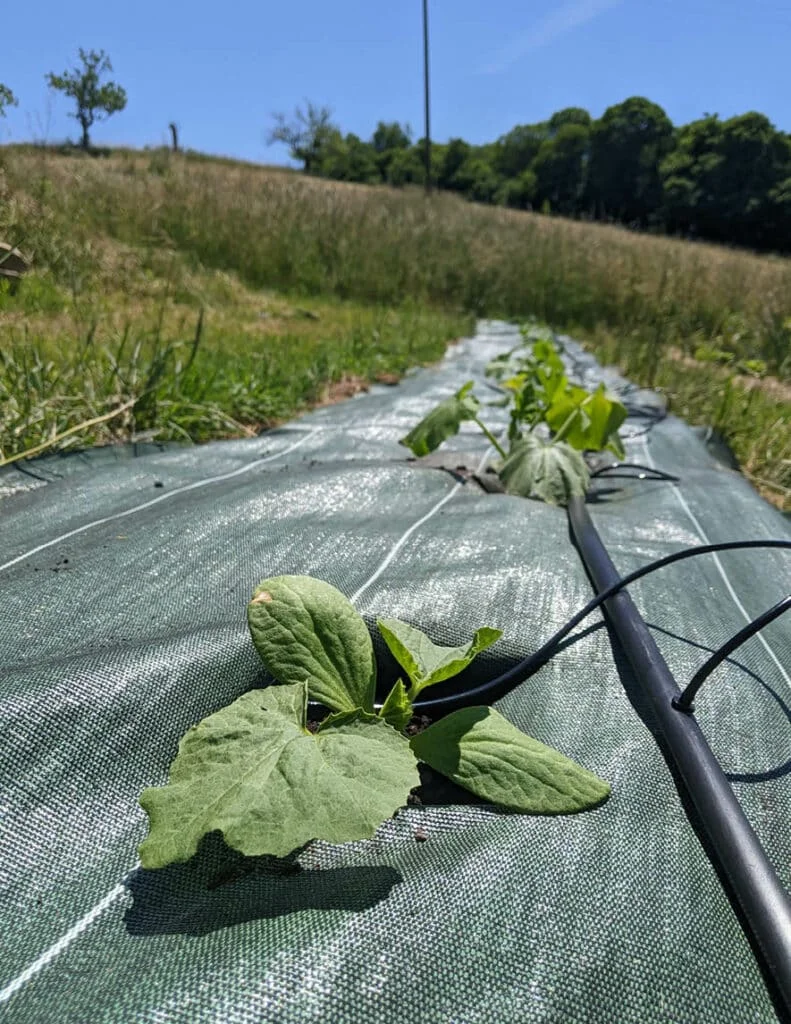
Be careful, everything is about water in the vegetable garden! The crops are plants, and plants are water. Biological soil is animal life, and all animal life is water. Every day, all these living organisms must transpire, grow, produce… This requires water consumption. Fortunately, this need is sometimes met by rain. But in summer, even sometimes from spring, this resource can quickly run low. You need to know how to water, 1 to 10 liters per day per square meter in the worst weather scenarios with heatwaves and wind.
So, have the easiest access to water possible. Sometimes it’s from the mains, or a spring, a borehole, a well, rainwater collection tanks… whatever you can have on hand. Then, as soon as there is a lack of rain, it’s up to you to provide this precious resource to keep the living soil and crops alive.
The goal is to have a constantly moist soil, like a wrung-out sponge, as soon as you scratch two or three centimeters of soil at the surface. This indicates that the water reserve is not empty, that biological activity is thriving, and that the roots of the crops find the necessary water for the plants to live, transpire, grow, and produce our future harvests.
A word on mulching
In addition to composts and organic fertilizers, ideally, you need to regularly add coarse organic matter.
This nourishes macro-organisms, protects your soil, reduces water needs, reduces weed growth, and lessens the mechanical work of the soil. Hay, straw, leaves...